

Redefining “Real”: Why It’s Time to Stop Dismissing Psychic Experiences
People often assume that if something is real, science should already understand it. But human knowledge is nowhere near complete — our collective knowledge is constantly expanding to include what was once considered impossible. When you look closely at what we don’t know, and what science is only beginning to explore, psychic and intuitive experiences stop sounding irrational. They start sounding surprisingly plausible.
We Still Can’t Explain Some of the Biggest Questions in Existence
For all our progress, some of the most fundamental mysteries remain unsolved:
- Consciousness. We still don’t know how awareness arises or why we have subjective experience. Consciousness remains one of science’s deepest puzzles.
- Why we’re here. There’s no scientific consensus on the purpose or origin of life; this remains one of humanity’s oldest unanswered questions.
- Intuition. People often sense things before the mind has explicit information — and science has no definitive explanation.
- Space Apparently Has No End — And We Can’t Comprehend That. Scientists acknowledge that we don’t know the true size or shape of the universe. The universe is expanding, but not into anything we can point to. This is one of the most mind‑bending scientific truths we have: we live inside something that appears to have no end, no outside, and no clear explanation. Our brains are wired for limits. Infinity breaks the system. If the universe itself defies logic, it’s not unreasonable to imagine that human consciousness might also operate in ways we don’t yet understand.
These are not fringe curiosities. They are central gaps in our understanding of reality.

So How Could Psychic Experiences Be Scientific?
If you strip away the stereotypes and look at what science is actually discovering, the idea of psychic or intuitive perception becomes far more reasonable. Below are distinct reasons that connect what we don’t know to what might be possible.
1. The universe is connected in surprising ways
Quantum physics shows that particles can become entangled, meaning they affect one another instantly across distance. If the building blocks of reality can exhibit non‑local connections, it’s not absurd to consider that consciousness might also have non‑local aspects. This doesn’t prove psychic phenomena, but it makes them conceivable.
2. Consciousness remains unexplained
Neuroscience maps correlations between brain activity and experience, but it cannot yet explain why subjective awareness exists. If we don’t know what consciousness is, we can’t confidently rule out capacities we haven’t measured.
3. Intuition is real and under‑researched
Intuition is real, even if we don’t fully understand it. Things like suddenly sensing danger, thinking of someone right before they call, or feeling the mood in a room happen all the time. They might come from our brain’s knack for spotting patterns, tiny sensory signals we miss, or kinds of perception science hasn’t figured out how to measure
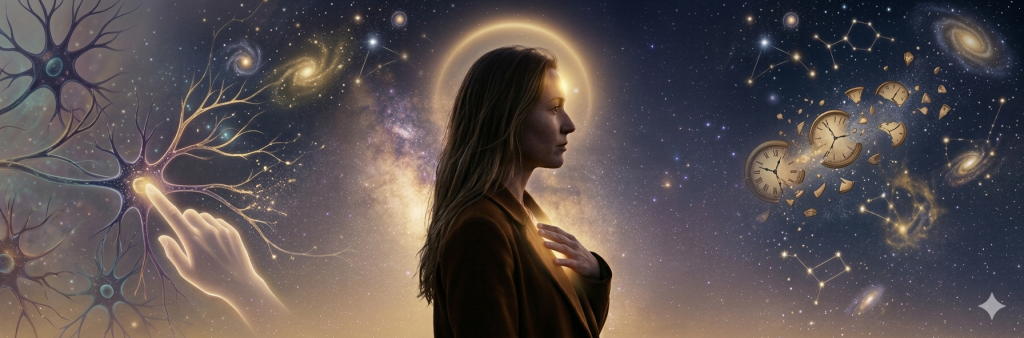
4. The brain is far more adaptable than we once thought
Neuroplasticity overturned the idea that the adult brain is fixed. If the brain can rewire, heal, and adapt, it’s plausible it could develop or access modes of perception beyond our current models.
5. Most of the universe is invisible to us
Dark matter and dark energy appear to make up 95% of the universe, yet remain undetected by direct observation. If most of reality is effectively invisible, it’s reasonable to consider that human perception might also reach into domains we haven’t mapped.
6. Time may not be strictly linear
Contemporary physics raises serious questions about the nature of time. If time is more flexible or layered than everyday experience suggests, then phenomena that seem like “knowing the future” could be forms of non‑linear perception rather than supernatural exceptions.
Science Is Often Wrong Before It’s Right
History shows that widely held scientific certainties can be overturned:
- The Earth was once thought to be the center of the universe.
- Disease was once blamed on “bad air” until germ theory transformed medicine.
- Atoms were once considered indivisible; subatomic particles proved otherwise.
- The adult brain was once thought static; neuroplasticity proved it dynamic.
Every era thinks it has the answers until new evidence appears, so it makes sense to greet psychic experiences with playful curiosity—open to possibility and eager to see what the evidence reveals.

What This Means for Skepticism About Psychic Ability
- Belief doesn’t have to be blind. You don’t have to force belief or disbelief. If an experience doesn’t fit neatly into what you already know, let it be something you explore rather than something you judge.
- Skepticism is healthy, but so is openness. Science advances by testing anomalies, not by dismissing them out of hand.
- Psychic experiences live in the “not yet understood.” They don’t contradict science; they point to areas where science hasn’t yet developed the tools or theories to measure what’s happening.
Conclusion
Is psychic experience “scientific”? Not yet in the conventional sense. But when you consider the mysteries of consciousness, the strangeness of quantum physics, the infinite expanse of space, the invisibility of most of the universe, the adaptability of the brain, and the possibility that time isn’t strictly linear, psychic phenomena stop being obviously impossible. They become plausible hypotheses worth curiosity and exploration.
That’s not naïve. It’s not “woo woo.” It’s open‑minded, grounded curiosity — the same impulse that drives science forward.
~Tim Thomas
Psychic • Medium • Teacher
About the Author: Tim Thomas is a psychic medium and teacher who helps people reconnect with loved ones in spirit and gain clarity through practical intuitive insight. He offers private readings, classes, and coaching.









Fabulous article, thank you so much
Thanks, Angela. I’m glad you enjoyed it.