
Why Validation Is the Missing Piece in Intuitive Development
One of the biggest misconceptions people have about intuition is that it’s some rare, mystical thing that only a few people are born with. In reality, most people are already getting intuitive information all the time — they just don’t trust it because they’ve never had a way to validate it.
And without validation, intuition becomes something you second‑guess instead of something you develop.
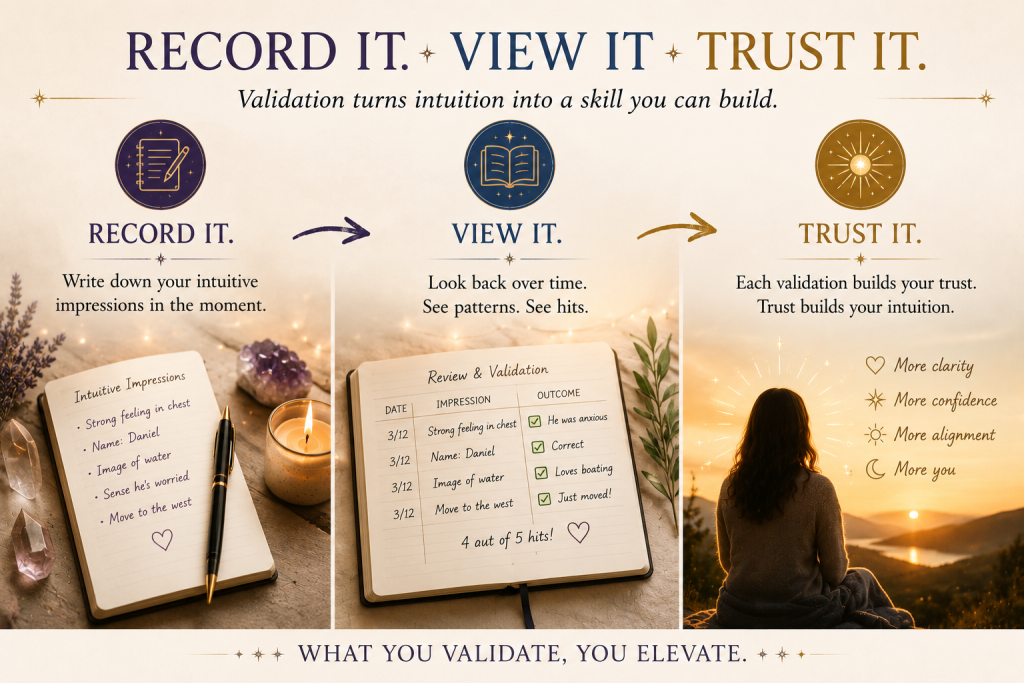
You Can’t Validate What You Don’t Record
This is the part most people skip over, but it makes all the difference:
If you don’t write down your impressions, you won’t remember them accurately later.
Not because you’re doing anything wrong — because the mind edits. It fills in blanks. It smooths over details. It rewrites things to match what you think happened. Or what you wish or fear would happen.
If you don’t record your intuitive hits in the moment, you lose the ability to validate them later. And when you can’t validate them, you end up training yourself to dismiss them.
People tell me all the time, “I never get anything right,” and then they start keeping track and realize they were getting hits all along — they were just dismissing them.
Sometimes Intuition Makes Sense Later — Sometimes Much Later
Another thing people don’t realize is that intuitive information doesn’t always come with context or explanation. You might get an impression that doesn’t match anything happening in your life right now. You might sense something that feels random or out of place.
And then, months or even years later, it suddenly makes sense.
That doesn’t mean you were wrong. It means even when you’re focused on one moment or one decision, intuition may respond with something related but not tied to the exact timeframe you had in mind. With practice, you can usually target it more precisely, but there will always be times when the meaning only becomes clear in hindsight.
That’s just how intuition works — it doesn’t always follow the logical timeline we think it should.
Validation Builds Trust — And Trust Builds Skill
Intuition is a lot like a muscle.
You don’t strengthen it by thinking about it.
You strengthen it by using it.
You can’t build a muscle without working out. And you can’t strengthen your intuition without practice.
When you get validation — even small validation — it reinforces your trust in your intuitive senses. You start to recognize the feeling of pure intuitive information versus the feeling of fear, logic, or wishful thinking. You start to trust your first impressions instead of talking yourself out of them.
That’s when intuition starts to become consistent instead of questionable.
Why Practicing Intuition Only on Yourself Slows Your Growth
This is a big one.
When you use intuition only on yourself, it can be challenging to discern it from your own thoughts, emotions, hopes, fears, and logic. It’s hard to tell what’s intuition and what’s:
- something you want
- something you’re afraid of
- something you already know
- something you’ve assumed
- something you’ve over‑analyzed
It’s not impossible — it’s just harder.
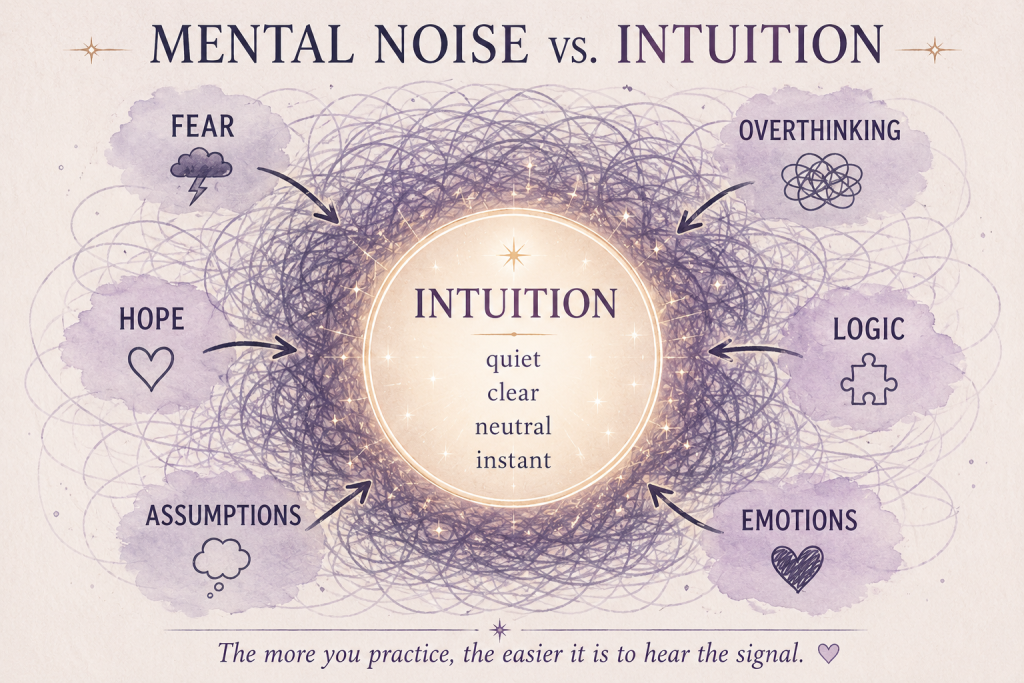
When you read for someone else, you’re not dealing with the same mental noise you have with yourself. You might know the person, but you don’t know all the details of what they’re navigating — or how your intuitive information fits into their bigger picture.
That’s when you start to recognize pure intuitive information — the stuff that comes in without your personal filters attached. And when someone can immediately confirm or clarify what you sensed, your learning curve jumps dramatically.
What many people don’t realize:
You don’t have to want to be a professional psychic to read for others.
You can do it socially, experimentally, and just for fun.
Some of the best intuitive growth happens in low‑pressure, playful settings.
A Personal Story About Validation (and How It Changed My Path)
Early in my own development, I had a reading with a professional psychic. She told me right away, very matter‑of‑factly, that she saw me teaching others someday.
I burst out laughing.
I remember involuntarily laughing because it felt so unexpected. I wasn’t dismissing her — it just wasn’t something I could picture for myself at all back then.
Fast forward about ten years… and teaching intuitive and mediumistic development has become something I genuinely love doing. It feels natural to me in a way I never expected back then.
That moment didn’t make sense at the time — but it was validated later. And it ended up being one of the most accurate intuitive hits anyone has ever given me.
Why Validation of Intuition Changes Everything
Validation gives you:
- a record of what you sensed
- confirmation of what was accurate
- clarity about how intuition works for you
- confidence to trust your first impressions
- a way to separate intuition from emotion or logic
- a path to consistent intuitive development
Without validation, intuition feels like guesswork.
With validation, it becomes a skill you can actually build.
If You Want a Place to Practice With Others
Intuition develops best in community — somewhere you can try things, compare experiences, and get real feedback. It doesn’t have to be serious or professional. It can be playful, social, and something you explore because you’re curious.
If you’re looking for a space like that, I run ongoing classes and practice groups where you can explore intuition in a supportive, low‑pressure way. You can always find the latest offerings on my classes page
About the Author: Tim Thomas is a psychic medium and teacher who helps people reconnect with loved ones in spirit and gain clarity through practical intuitive insight. He offers private readings, classes, and coaching.